

Augusta Savage's Clay Archive (1892-1962): A Teaching-Artist in the Harlem Renaissance
Article Sidebar
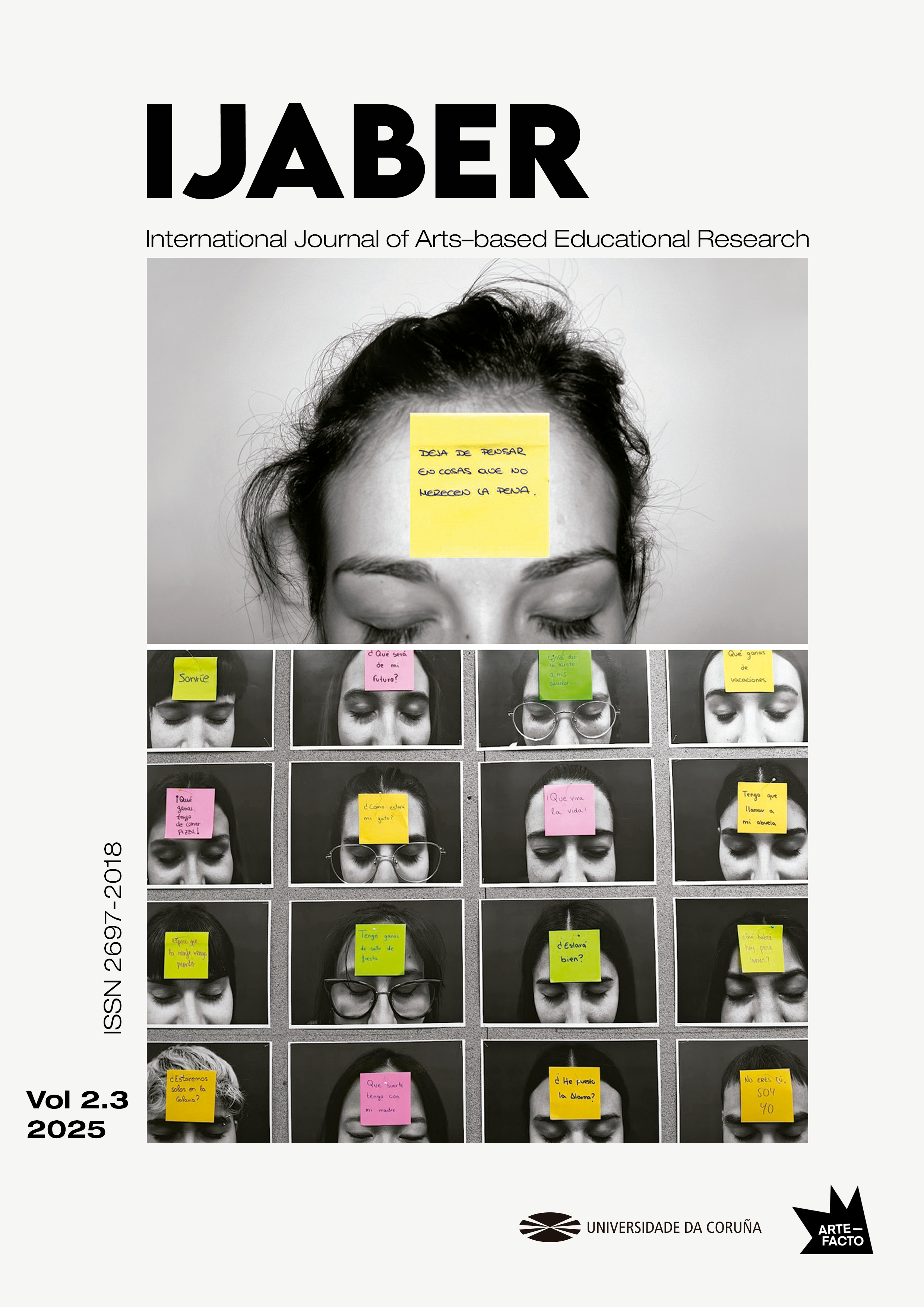
Main Article Content
DOI:
https://doi.org/10.17979/ijaber.2025.2.3.11918Abstract
Augusta Savage, African American sculptor and educator, was a key figure in the Harlem Renaissance. This article proposes an exploration of her pedagogical practice—scarcely documented—through what we call her clay-archive, a speculative corpus that brings together student testimonies, fragmentary records, and apocryphal sources. The research delves into her teaching during the first half of the twentieth century, considering her biography as a means of accessing her methodology and her relationship to the materiality of clay. From a perspective that weaves together art, life, and teaching, the article offers a reading of Savage as an artist-educator, shedding light on a legacy marginalized due to her gender, race, and class. In doing so, it seeks to incorporate this counter-hegemonic reference into the narratives of art education, connecting figures like Savage with the diversity present in today’s classrooms.
Keywords:
Article Details
References
Alston, C. (1968, octubre 19). Oral history interview with Charles Henry Alston. Archives of American Art, Smithsonian Institution. https://www.aaa.si.edu/download_pdf_transcript/ajax?record_id=edanmdm-AAADCD_oh_212620
Bearden, R., & Henderson, H. (1993). History of African-American Artists: from 1792 to the present. Pantheon.
Bey, S. (2017). Augusta Savage: Sacrifice, Social Responsibility, and Early African American Art Education. Studies in Art Education. 58 (2): 125–140. https://doi.org/10.1080/00393541.2017.1292383
Bibby, D. L. (1988). Augusta Savage and the Art Schools of Harlem. Schomburg Center for Research in Black Culture, The New York Public Library.
Burke, S. (1990). Dr. Selma Burke: A National Treasure [video]. Mooresville Public Library Local History and Archives, OaHist 1.2.1.23.
Bush, G. G. (1889). "History of education in Florida". Text Materials of Central Florida. 957.
De Leon C. (2021, marzo 30). “Augusta Savage: the Black woman artist who crafted a life she was told she couldn’t have”. The New York Times. https://www.nytimes.com/2021/03/30/us/augusta-savage-black-woman-artist-harlem-renaissance.html
Etinde-Crompton, C., & Crompton, S. W. (2019). Augusta Savage. Sculptor of the Harlem Renaissance. Enslow Publishing, LLC.
Farrington, L. E. (2011). Creating their own Image: the history of African-America Women Artists. Oxford University Press.
Ferguson, J. B. (2007). The Harlem Renaissance: A brief history with documents. Bedford/St. Martin's.
Frazier, E. F. (1940). The Negro Family in the United States. University of Chicago Press. https://archive.org/details/negrofamilyinthe031737mbp/page/n7/mode/2up
Hayes, J.M. (2021). Augusta Savage: Renaissance Woman. D Giles Ltd https://stars.library.ucf.edu/cfm-texts/957
Heller, N. G. (1987), Women Artists: An Illustrated History. Abbeville Press, Publishers.
Ikemoto, W. N. E. (2022). Lost masterpieces. Stolen, Damaged, Mislaid, Destroyed - The World's Most Elusive Works of Art. DK Secret Histories.
Honorato, C. (2018). Discursos de autolegitimação do ensino da arte: alguns problemas histórico-conceituais. Revista GEARTE, 5(3). https://doi.org/10.22456/2357-9854.86132
Kirschke, A. H. (2014). Women Artists of the Harlem Renaissance. University Press of Mississippi.
Knight, G. (1977). Interview with Gwendolyn Knight [video]. Audacious Women Productions.
Lawrence, J. (1941). The Migration Series. Museum of Modern Art.
Lawrence, J. (1968, agosto 10). Oral history interview with Jacob Lawrence. Archives of American Art, Smithsonian Institution. https://www.aaa.si.edu/collections/interviews/oral-history-interview-jacob-lawrence-11490
Lawrence, J. (1977). Interview with Jacob Lawrence [video]. Audacious Women Productions.
Lehmann-haupt, C. (2005, febrero 27). "Gwendolyn Knight, 91, Artist Who Blossomed Late in Life, Is Dead". The New York Times. https://www.nytimes.com/2005/02/27/obituaries/gwendolyn-knight-91-artist-who-blossomed-late-in-life-is-dead.html
Lewis, S. (2003). African American Art and Artists. University of California Press.
Matzon, G. C. (1909). Clays. Notes on the Clays of Florida. https://pubs.usgs.gov/bul/0380k/report.pdf
Nelson, M. & Lawson, T. (2022). Augusta Savage: The Shape of a Sculptor's Life. Christy Ottaviano Books.
Peixotto, E. (April 23, 1923). Letter from Ernest Peixotto to Ernestine Rose,. W. E. B. Du Bois Papers (MS 312). Special Collections and University Archives, University of Massachusetts Amherst Libraries.
Poston, T. R. (enero 1935). Augusta Savage. Metropolitan Magazine.
Ríos Villar, L. (2024). Análisis y revisión artística del procedimiento pictórico de Tadeo Haenke en sus estudios de botánica en América. [Tesis doctoral, Universidad Complutense de Madrid] docta https://hdl.handle.net/20.500.14352/93616
Savage, A. (20 de mayo de 1923). Augusta Savage on Negro Ideals. The New York World.
Savage (1939). “Opening of the Salon of Contemporary Negro Art”. Schomburg Center for Research in Black Culture in Harlem.
Schroeder, A., & Bereal, J. (2009). In her Hands: the story of sculptor Augusta Savage. Lee & Low Books.
Wheat, E. H. (1990). Jacob Lawrence: American Painter. University of Washington Press.